














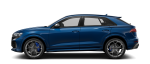

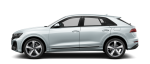








The Audi A6 Sportback e-tron performance has achieved a new milestone after covering 1,338 kilometers on a single charge, setting a new Guinness World Records mark.
The achievement comes despite the vehicle’s official range of up to 777 kilometers according to WLTP, meaning it traveled an additional 561 kilometers, or around 72% beyond its official rated range.
Exceptional Energy Efficiency
During the record attempt, the Audi A6 Sportback e-tron performance achieved an energy consumption figure of just 7.09 kWh per 100 kilometers.
The vehicle is equipped with a 100 kWh gross battery, with 94.9 kWh of usable capacity.
The result highlights the high level of efficiency the vehicle can achieve under conditions optimized to reduce energy consumption.
Aerodynamic Design for Greater Efficiency
The exterior design plays an important role in the efficiency of the Audi A6 Sportback e-tron performance.
With a drag coefficient of just 0.21, the vehicle has the lowest drag coefficient of any production Audi. This helps reduce aerodynamic resistance and improve overall energy efficiency.
The vehicle is also based on Audi’s advanced electric platform and delivers up to 367 PS, while its regenerative braking system can recover energy at up to 220 kW.
A Record Achieved Under Efficiency-Focused Conditions
The record was achieved during a journey lasting more than 45 hours on public roads in Poland.
It is important to note that the 1,338-kilometer figure does not represent the vehicle’s expected range in everyday driving.
The record attempt was conducted under conditions specifically focused on maximizing efficiency, including relatively low speeds and an average temperature of around 15°C.
The journey demonstrates how factors such as speed, temperature, aerodynamics, and driving style can significantly influence energy consumption and range in electric vehicles.
A New Milestone in Electric Mobility
The Audi A6 Sportback e-tron performance exceeded the previous single-charge range record by 133 kilometers.
The achievement highlights the vehicle’s potential for exceptional efficiency through the combination of aerodynamic design, advanced electric technology, and intelligent energy management.
Frequently Asked Questions
What is the official range of the Audi A6 Sportback e-tron performance?
The vehicle offers an official range of up to 777 kilometers according to WLTP, depending on equipment and test conditions.
How did the vehicle achieve 1,338 kilometers on a single charge?
The record was achieved under conditions designed to maximize efficiency, including relatively low speeds and moderate temperatures. Therefore, the record figure should not be considered the vehicle’s expected range in everyday driving or on highways.
What was the vehicle’s energy consumption during the record attempt?
The Audi A6 Sportback e-tron performance achieved an average consumption of 7.09 kWh per 100 kilometers during the record attempt.
What technologies contribute to the Audi A6 Sportback e-tron’s efficiency?
Key factors include its aerodynamic design, an exceptionally low 0.21 drag coefficient, advanced electric technology, and a regenerative braking system capable of recovering energy at up to 220 kW.


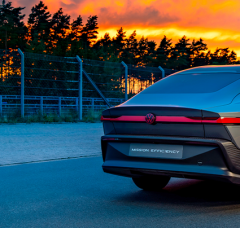
A drag coefficient of 0.158, consumption of 6.48 kWh/100 km, and a certified 1,278 km (794-mile) road trip from Wolfsburg to Vienna with just one charge along the way
[City], Palestine – [Date], 2026 – On September 14, 2026, Volkswagen unveiled Mission Efficiency, a near-production, four-seat electric coupé prototype that set three world records: the lowest drag coefficient of any road-registered car (Cd 0.158), energy consumption of just 6.48 kWh per 100 km, and the title of most efficient near-production EV in the category of everyday-usable four-seat electric vehicles, as certified by the Record Institute Germany (Rekord-Institut für Deutschland). United Motor Trade (UMT), the exclusive Volkswagen dealer in Palestine, is sharing the achievement with its audience in Palestine.
Key Facts
|
Item |
Details |
|
Manufacturer |
Volkswagen |
|
Model |
Mission Efficiency |
|
Type |
Near-production electric prototype; road-registered 2+2 coupé |
|
Unveiled |
September 14, 2026 |
|
Drag coefficient (Cd) |
0.158, the lowest of any road-registered car |
|
Lowest consumption |
6.48 kWh/100 km (constant 68 km/h, no climbs, A/C off) |
|
Certified road trip |
1,278 km (794 mi), Wolfsburg to Vienna via Poland and Czechia |
|
Real-world consumption |
7.51 kWh/100 km incl. charging losses (6.89 without) |
|
Charging on the trip |
Once only; 164 km (102 mi) of range left on arrival |
|
Motor |
99 kW (135 PS), from the ID. Polo |
|
Battery |
54.9 kWh net, from the ID. Polo |
|
Dimensions |
Length 4,775 mm, height 1,392 mm, luggage 481 L |
|
Series production |
None announced; a technology demonstrator |
What three world records did Mission Efficiency set?
- Lowest drag coefficient for a road-registered car: Cd 0.158.
- Lowest energy consumption: 6.48 kWh/100 km at a constant 68 km/h, with no climbs and the air conditioning off.
- Most efficient near-production EV in its class: achieved by pairing exceptional aerodynamics with the highly efficient electric motor from the ID. Polo.
How did it perform on a real road trip?
Volkswagen went beyond lab measurements. The car completed an officially documented 1,278 km drive from its development center in Wolfsburg, through Poland and Czechia, to Vienna. Average real-world consumption was 7.51 kWh/100 km including charging losses (6.89 kWh/100 km without), at an average speed of 67.72 km/h and a top speed of 138 km/h. The battery was charged only once during the trip, and the car arrived with 164 km of range remaining.
What makes it so efficient?
Every design decision serves aerodynamics. The teardrop body has a small frontal area of 2.08 m², active cooling flaps, a fully covered underbody, enclosed rear wheels and flush door handles. As a result, it uses more than 30% less energy than a standard ID. Polo at speeds above 80 km/h. At 140 km/h, Mission Efficiency needs about the same energy as an ID. Polo does at 100 km/h.
Why did Volkswagen focus on the wheels?
Wheels cause 25–30% of aerodynamic drag. The wheel arches are shaped to hug the tires and reduce turbulence, and the rims carry patented internal air deflectors that keep air out. Volkswagen also developed special tires with Continental, based on the EcoContact 7, with rolling resistance about 25% lower than the best class threshold on the EU tire label.
What other technologies does it use?
- Rear electromechanical brakes: used for the first time and developed with AUMOVIO. They reduce friction and improve energy recovery and cornering stability.
- 370 W solar cells: on the roof and rear lid. They power the electrical systems and can add up to 30 km of range per day, depending on season and weather.
- Lightweight build: an aluminum structure with carbon-fiber and aramid composites, and a pared-back cabin that uses the driver's own phone or tablet instead of an infotainment screen, with a portable Bluetooth speaker in place of a conventional audio system.
What are the specifications?
Mission Efficiency is a four-seat (2+2) coupé, 4,775 mm long and 1,392 mm high, with 481 liters of luggage space. The rear seats suit passengers up to about 1.60 m tall. It uses a 99 kW (135 PS) motor and a 54.9 kWh net battery, both from the ID. Polo. The car holds European road registration and meets safety and crash requirements.
Frequently Asked Questions
Will Mission Efficiency go on sale?
No. Mission Efficiency is a prototype that showcases Volkswagen's current technical capabilities. Volkswagen has not announced plans for series production.
What is the drag coefficient of Mission Efficiency?
Cd 0.158, the lowest ever recorded for a road-registered car.
How much energy does Mission Efficiency use?
6.48 kWh/100 km under ideal test conditions, and 7.51 kWh/100 km including charging losses on a real 1,278 km road trip.
How many times was it charged between Wolfsburg and Vienna?
Once. It arrived in Vienna with 164 km of range left.
How is Mission Efficiency related to the ID. Polo?
It uses the same 99 kW motor and 54.9 kWh battery as the ID. Polo, and uses over 30% less energy above 80 km/h thanks to its aerodynamics.
Who is the Volkswagen dealer in Palestine?
United Motor Trade (UMT) is the exclusive Volkswagen dealer in Palestine.